
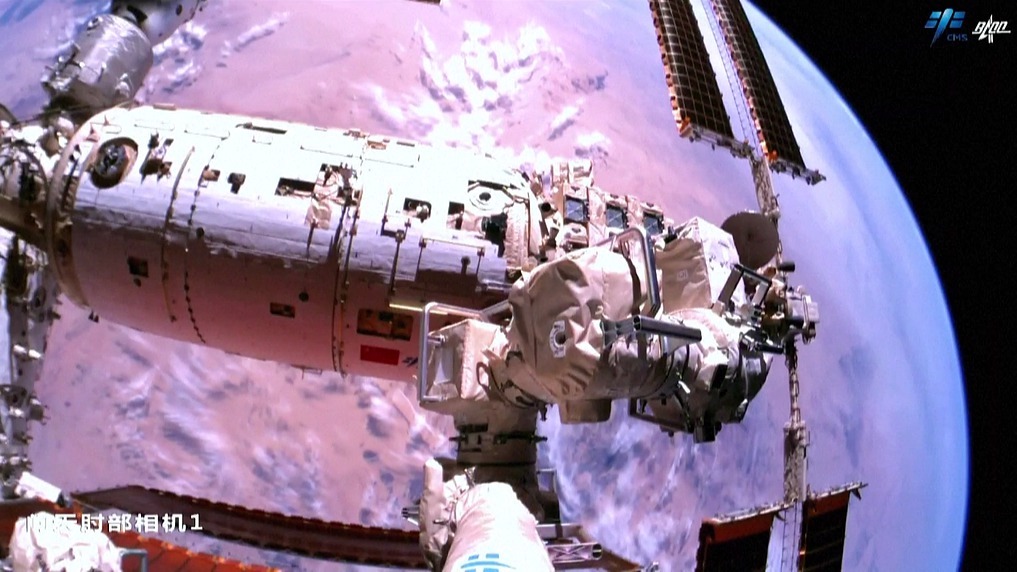
China's space station operating in orbit. /CMSA
China's space station made steady progress in the development of space science, application experiments and technology tests in 2025, according to China's Technology and Engineering Center for Space Utilization (CSU) under the Chinese Academy of Sciences.
The space station has established a range of scientific facilities covering multiple fields including life sciences, microgravity physics, and new space technologies and applications, providing critical support for the implementation of core scientific missions.
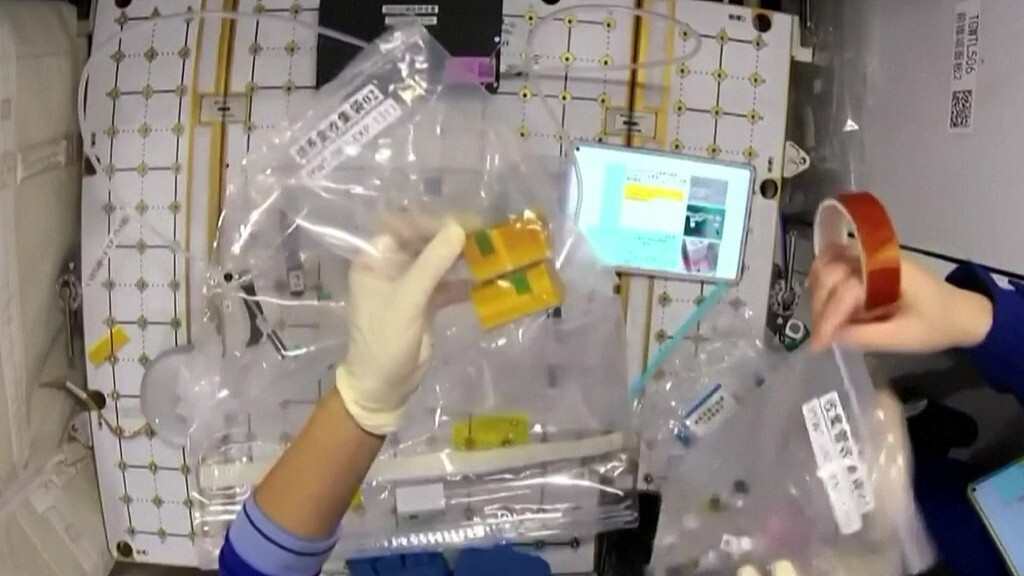
Samples of space life science experiments by China's Shenzhou-20 mission aboard the space station. /CMSA
In the past year, 31 new scientific and application projects were implemented in orbit on the space application system. About 867.5 kilograms of scientific materials, including experimental modules and samples, were sent to space, while 83.92 kilograms of space science experiment samples were returned to Earth. Over 150TB of scientific data were collected, and scientific teams from various fields have made significant contributions, producing a series of original, cutting-edge and innovative advancements, with over 50 patents granted.
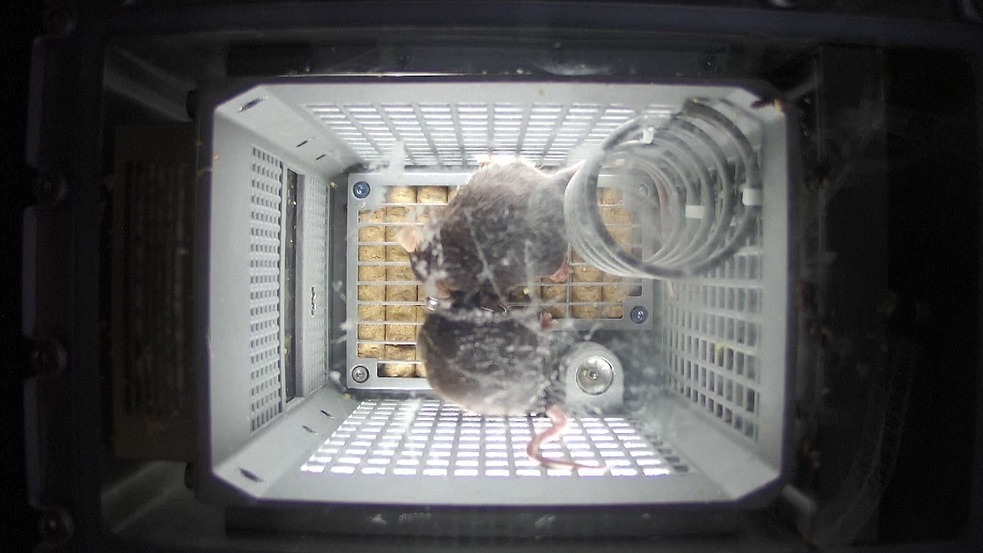
China's space mice aboard the space station. /VCG
In the field of space life sciences, China successfully conducted its first-ever mouse experiment aboard the space station. The mission has initially established a full-cycle experimental and engineering system for space-based small mammal research from ground selection to return, laying an important foundation for future systematic research on the impact of space environment on mammals.
In a world-first, China also launched space station experiments on the combined effects of sub-magnetic fields and microgravity on biological systems, which revealed behavioral and genetic changes in animals under this dual space environment, paying the way for life and health studies and protection in deep space exploration.
The country also conducted an in-situ electrochemical and optical study on lithium-ion batteries for space applications aboard the space station. The research is expected to further advance the fundamental electrochemical theories and provide a basis for optimizing existing in-orbit battery systems, as well as for designing next-generation space batteries with higher energy density and safety.
Ba Jin, senior engineer at the CUS, said two flagship astronomical facilities will be launched for the space application system in the future.
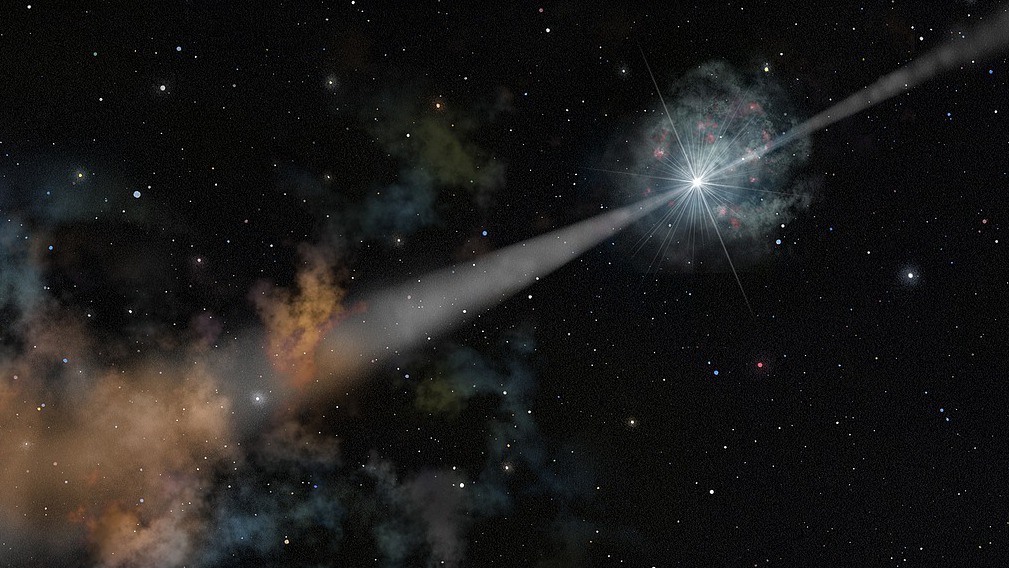
Illustration of the gamma ray bursts. /VCG
The first is the China Space Station Survey Telescope (CSST), which will contribute to significant scientific discoveries in cosmology, neighboring galaxies and the Milky Way. The second is the High Energy Cosmic Radiation Detection (HERD) facility. It will probe cosmic rays with high sensitivity to deepen understanding of dark matter, the origin of cosmic-ray acceleration and gamma-ray surveys. (CGTN)
A novel experiment on the fundamental science of lithium-ion batteries has been carried out aboard China's Tiangong space station, according to the Dalian Institute of Chemical Physics of the Chinese Academy of Sciences on Wednesday. This experiment, conducted by the three astronauts comprising the Shenzhou-21 crew, aimed to uncover the mechanisms behind battery performance by leveraging the unique conditions of space.
Of the four mice involved in a recent mission aboard China's space station, one female has now successfully birthed healthy offspring on Earth, the Technology and Engineering Center for Space Utilization (CSU) of the Chinese Academy of Sciences (CAS) has announced. The four mice were sent into space aboard the Shenzhou-21 crewed spaceship on Oct. 31, and were housed in a specialized habitat on the space station before returning to Earth on Nov. 14.

86-10-68597521 (day)
86-10-68597289 (night)

52 Sanlihe Rd., Xicheng District,
Beijing, China (100864)
Copyright © 2002 - Chinese Academy of Sciences


